
A platform team we talked with earlier this year had already run the numbers before GitHub announced anything. Their monorepo pipeline was burning through roughly 40,000 build minutes a month on standard Linux runners, mostly C++ and Rust compile jobs feeding a nightly regression suite. When word got around that GitHub was reworking Actions pricing for 2026, their first assumption was that the number on their invoice was about to climb. What actually happened was messier than that, and understanding the mess matters more than the headline.
What Actually Changed in GitHub’s Pricing
On December 16, 2025, GitHub published two decisions in the same changelog post, and they pulled in opposite directions. GitHub-hosted runner prices were set to drop by up to 39 percent across machine types starting January 1, 2026, a change confirmed in GitHub’s own changelog (github.blog/changelog/2025-12-16-coming-soon-simpler-pricing-and-a-better-experience-for-github-actions). Buried in the same post was something else: a new $0.002-per-minute “Actions cloud platform charge” on self-hosted runner usage in private repositories, arriving March 1, 2026. Teams running their own hardware would start paying GitHub for orchestration, even though GitHub never touches the compute itself.
That second piece did not survive contact with the developer community. Within two days, GitHub postponed the self-hosted charge, in its own words, to take more time and re-evaluate the approach, while the hosted-runner price cut went ahead as planned. The pause has held since. GitHub’s changelog hasn’t been updated since December 17, 2025, and no relaunch date exists. Postponed is not cancelled, and we’ll get to why that distinction matters for planning. But the plain fact right now: self-hosted runners on private repositories are still free of GitHub’s platform fee.
One developer who runs self-hosted runners in production summed up the reaction in a public GitHub discussion thread, reported by devclass.com: they calculated the proposed charge would have added over $140 a month to their bill, just for jobs already running on hardware they owned and paid for. That kind of math, multiplied across every enterprise account with a large self-hosted fleet, is almost certainly why the plan got pulled so fast.
So Why Do CI Bills Still Feel Like They’re Climbing
The sticker price went down. The self-hosted charge never landed. And yet this still reads like a cost story, not a relief story, because the per-minute rate is only one side of the bill. The other side is how many minutes get consumed, and that number has been climbing for reasons that have nothing to do with GitHub’s pricing team.
GitHub’s own Octoverse 2025 report put pull requests merged at 43.2 million a month on average, up 23 percent year over year, alongside nearly a billion commits pushed across 2025, up roughly 25 percent. GitHub Copilot’s coding agent alone was credited with authoring more than a million pull requests in just five months. None of that volume is free to run through a pipeline. Every one of those commits and pull requests triggers workflow runs, and workflow runs are exactly what gets billed by the minute.
The mechanism is straightforward once you say it out loud: more AI-assisted code means more commits, more pull requests, and more matrix builds across operating systems and architectures, and all of that lands on the same CI layer that hasn’t gotten proportionally faster. Our own telemetry across customer pipelines shows the same shape, teams whose per-minute list price fell in January still saw their total minute count for the month tick upward, because the number of things triggering a build grew faster than the discount shrank the per-unit cost.
Common Mistakes Teams Make Reading This Story
The most common mistake is treating the 39 percent list-price cut as the whole story and closing the tab there. It’s real, and it does lower the bill for teams whose usage stays flat, but usage rarely stays flat, and a team that keeps running the same workflows on a growing number of pull requests will still see its total spend move in the wrong direction even at the new, lower rate.
A second mistake is assuming the postponed self-hosted charge is dead. GitHub explicitly framed the pause as re-evaluation, not retraction. The industry is already moving the same direction regardless of what GitHub ultimately decides: Bitbucket has announced it will start charging for self-hosted runner usage too. Take that seriously even if your organization never touches GitHub Enterprise Server, which remains exempt from all of this. If you’re already running GES, though, check for yourself; the exemption is real.
A third mistake is benchmarking against the list price alone rather than the realized cost. Look at GitHub’s own rate card: a standard 2-core Linux runner runs $0.006 a minute. Step up to 8 cores and it’s $0.022. Sixteen cores, $0.042. MacOS sits well above all of that. A team that quietly moved from 2-core to 8-core runners, just to keep pace with heavier, AI-assisted build graphs, can watch its bill climb even though every individual rate on that card went down.
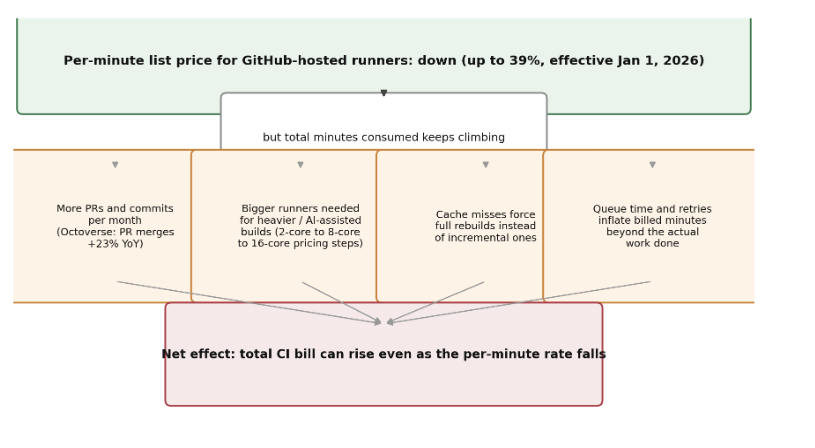
Figure: the list-price cut and the total-spend trend are two different lines. Only one of them is guaranteed to move in your favor.
Where the Real Cost Hides
Beyond the headline rate, four things tend to quietly inflate a GitHub Actions bill. Queue time is one: a job waiting for a runner to spin up still eats wall-clock time that frustrates developers even when it isn’t directly billed, and teams respond by buying more concurrency, which is billed. Self-hosted maintenance is another: the runners may be free of GitHub’s fee, but patching, scaling, and troubleshooting them is not free labor, and that cost rarely shows up on the same line item as the CI bill, which is part of why it gets underestimated. Cache misses are a third: a dependency bump or a cache eviction policy that’s slightly too aggressive turns an incremental build back into a full one, and the difference between those two can be an order of magnitude in minutes. And the growing share of AI-generated pull requests means more matrix jobs running the same checks across more operating systems and architectures, each one billed independently.
Four Paths Forward
There isn’t one right answer here, and the honest version of this section includes an entry for us, with the same scrutiny we’d apply to anyone else’s.
| Path | Pricing model | Effort to adopt | Where it falls short |
|---|---|---|---|
| Stay on GitHub-hosted runners as-is | Per-minute, list price down up to 39% from Jan 1, 2026 (see rate card) | None. This is the default. | Larger runners cost more. A standard 2-core Linux runner is $0.006/min; step up to 8-core and it’s $0.022/min, 16-core climbs to $0.042/min. Heavier builds still cost real money, even at the lower list price. |
| Self-host on your own hardware | Free of GitHub’s platform fee for now. The proposed $0.002/min charge was postponed in December 2025, not cancelled. | Moderate to high. You provision, patch, and scale the machines yourself. | The maintenance overhead is real and ongoing, and the postponed platform charge could return; BitBucket has already moved to charge for self-hosted runner usage, which suggests the industry direction, not just GitHub’s, is toward metering orchestration regardless of who owns the hardware. |
| Add caching or distributed compilation tooling (sccache, ccache, distcc, Icecream, actions/cache) | Free and open source. You still pay for the runner minutes underneath. | Low to moderate. Mostly configuration, not infrastructure. | These tools solve compute reuse, not orchestration or queue time, and they don’t offer cross-team or cross-org caching, so the benefit tends to plateau once a codebase or team grows past a certain size. |
| Managed accelerated runners (our own Build Runners is one example) | Vendor-priced; Incredibuild’s Build Runners is free during its early access phase. | Low. In our case it’s a runs-on label swap in an existing workflow file. | Still in early access, with limited availability and an application step, so it isn’t a same-day option for every team the way switching a runner label usually would be. |
On cost specifically: the cheapest path on paper, sticking with GitHub-hosted runners at the new rates, is not necessarily the cheapest path in practice once a pipeline needs 8-core or 16-core runners to keep pace with build size. Self-hosting removes GitHub’s per-minute rate entirely but replaces it with real infrastructure and headcount cost that’s easy to undercount because it’s spread across a platform team’s existing salary rather than itemized on an invoice. Open-source caching tools are the best pure cost play for a team that hasn’t outgrown a single shared cache, but the cross-team caching gap becomes a real tax as an organization scales past a few dozen engineers. Managed accelerated runners trade a subscription cost for both of those problems at once, at the price of being an additional vendor relationship to manage.
One mid-size fintech engineering team we spoke with during early access testing was averaging close to 40,000 minutes a month on 8-core Linux runners, largely C++ services with a slow, dependency-heavy build graph. After moving their slowest pipeline onto distributed, cached compilation, they cut wall-clock time on that pipeline from around 22 minutes to under 6. Here’s the catch, since a clean number like that is easy to oversell: their cache hit rate dropped sharply for a day or two every time a core dependency got bumped. The real-world average gain, in a typical sprint, ended up smaller than that best-case number suggests. They had to tune cache invalidation rules before the gain held steady. This is one team’s informal account from early testing, not a controlled benchmark, and we’d treat it that way.
Who Should Choose Which Path
A small team with light, infrequent builds is probably best served by staying on GitHub-hosted runners and letting the January price cut do its job; the volume simply isn’t there yet to justify anything more complex. A team that already has dedicated platform engineers and heavy, steady CI load, particularly one already running on-prem or reserved cloud capacity, is a natural fit for self-hosting, provided it goes in with eyes open about the postponed charge and the real maintenance cost. A team with a single dominant build bottleneck and a codebase that compiles the same dependencies over and over is a strong candidate for open-source caching first, since the fix is cheap and the ceiling is only a problem once the team is much larger. And a team whose CI cost is already a boardroom-visible line item, where engineers are waiting on builds long enough that it shows up in delivery metrics, is the profile managed accelerated runners are built for, ours included, though it’s fair to note that early access means it isn’t available to everyone on day one.
Where This Is Headed
In the near term, expect more CI platforms to test some version of what GitHub tried and pulled back. Bitbucket has already moved to charge for self-hosted runner usage, and it would be surprising if GitLab and CircleCI don’t eventually explore similar metering on their own self-hosted or hybrid runner options, since the underlying cost of running an orchestration control plane doesn’t go away just because the compute is customer-owned.
There’s a more speculative possibility here, and we’d flag it clearly as unconfirmed. CI could shift toward genuinely usage-based, vendor-agnostic compute marketplaces, where a team buys orchestration from one vendor and spot compute from whichever provider is cheapest that week. Some organizations already treat GPU capacity for AI training this way. That would decouple the two things GitHub’s 2025 announcement tried, and failed, to bundle into one fee. It’s a bigger architectural shift than anything on a roadmap today. There’s no confirmed timeline for it. But the incentives, on both the vendor side and the customer side, point in that direction over a multi-year horizon.
A Word on Incredibuild, Since We’re the Ones Writing This
Build Runners, our managed CI runner offering, is built specifically to remove the queue-time and caching problems described above without asking a team to change its workflow file beyond swapping a runs-on label. It’s currently in early access, offered free for three months to teams that apply and get in. It isn’t the right fit for every team on this list, either. It’s newer than the open-source tools mentioned above. Availability is limited while it’s in EAP. And a team that’s happy with its current self-hosted setup, one that isn’t hitting a real bottleneck, has little reason to add another vendor relationship on our timeline rather than theirs.
Key Takeaways
The 39 percent list-price cut on GitHub-hosted runners is real. The self-hosted platform charge that would have offset it for on-prem teams is genuinely postponed, not quietly back in effect. But list price was never the whole cost story. AI-assisted commits and pull requests keep growing, and most teams’ total CI minutes are climbing regardless of what the per-minute rate does. There’s no single universal fix here. It’s about matching your actual bottleneck, raw volume, cache efficiency, self-hosted overhead, queue time, to one of the paths above, and being honest about what each one doesn’t solve. If queue time and cache misses are what’s actually slowing your pipelines down, that’s the gap Build Runners is built to close, and the early access program is open to applications now.